Friday, August 26, 2011

Final Destination 5

A final destination that never seems to get to its destination...hmm....your in for a real treat this time. Final Destination 5 may be the last installment in the brand name but its proved time and time again "you can hide but you can't cheat death forever"...pretty don't you think?

The basic setup is again the same this time as well - Each installment begins with an enormous action set-piece (in this case, a suspension bridge collapse) that kills off character after character in a variety of shocking and grisly ways -- until the entire sequence is revealed to be a premonition. Final Destination 5 centers around Sam Lawton (Nicholas D’Agosto) who, after a brief moment of deja vu, remembers his gruesome vision and drags several of his co-workers off the aforementioned bridge before the collapse -- subsequently saving them from their pre-ordained deaths. As a result, “Death,” who does not like to be cheated, spends the remainder of the film hunting the survivors one by one -- using a string of complicated real-world setups to reclaim their lives.

But what is different this time? The success of the film owes a lot to director Steven Quale’s use of 3D. Final Destination 5 often catches the audience off-guard, and plays against expectations through its use of 3D. Obviously, things fly out of the screen, but this isn’t a film that’s attempting to create a rich and immersive experience -- it’s about toying with anticipation as well as delivering cathartic, over-the-top pay-offs. Most audience members are burning out on run of the mill 3D, but even naysayers will have to admit that Final Destination 5 makes interesting (and at times cringe-inducing) use of the format.

But its not only the 3D that makes a difference here but the different solutions of "toying with death". Previous installments had rather well humongous ways of cheating the star of the show a.k.a. "Death" - cheating death again, new life, etc. However, Final Destination 5, to its credit, offers a more straightforward solution -- the survivors can kill another person to appease death -- which not only makes more sense than prior films, but also drives the plot and characters forward in compelling and twisted ways. It’s a subtle addition that (surprisingly) isn’t a major focus of the story -- but adds an interesting dynamic as well as a few extra surprises by the end.
Speaking of beginnings, the opening set piece of the bridge collapse left me giddy. Every cast member seems to meet a vastly different demise with Candice taking the top award, something she manages to do once more. They are grisly and the sequence throws smart and interesting obstacles in their paths. The collapse itself feels thought out and well-researched, something a lazy sequel would never spend the time to do. The entire sequence looks gratifyingly real, but it is always risky going this far in the first quarter of a film. Outside of the bridge scene the gymnastic scene had to be the most brilliant one here. You can literally feel yourself sitting on the edge of the seat as Candice avoids one hurdle and stumbles over another. The sequence comes to an outrageously brutal demise that manages to feel rewarding in a sick way.

Both Nicholas D’Agosto and Miles Fisher (who plays Sam’s best friend, Peter), have surprisingly natural onscreen charisma -- especially given the ludicrous scenario and flat dialogue they’re expected to deliver. The rest of the cast is competent, and never really distract from the events that are unfolding -- but don’t make much of an impression, either. Most of the characters, as usual, are merely cannon fodder for the star of the film -- Death (and its creative killing methods).

On the whole Final Destination 5 is noticeably hollow without the cruel set pieces, and for that it will not reach much beyond its core audience. For those that are fans, though, there is much to be happy about, including a satisfying ending. Although the movie's logic gets a little dodgy by the closing credits (though no moreso than in prior installments) but definitely delivers some fun surprises and a number of great nods to the overarching Final Destination franchise. It’s arguably the second-best entry in the series (behind the original, of course) and should please fans as well as serve as a good re-entry point into the storyline for audience that may have passed on the last few installments.

Share/Bookmark

Wednesday, August 24, 2011

Captain America: The First Avenger


The last piece for the setting of multi-crossover superhero saga The Avengers, Captain America: The First Avenger after Iron man, The Incredible Hulk, Iron Man 2, and Thor. Its surprisingly well grounded and with the era a.k.a. WWII. And Director Joe Johnston really uses the setting and era to flourish Caps. story.

One of the great things about superhero comics is that while they’re all part of the same larger genre, there are countless variations within it. A dark gritty Batman comic is wildly different from the scientific utopianism of a Fantastic Four book, which is different from both the crime noir stylings of Daredevil and the classic heroism of a Superman title.

Captain America: The First Avenger, however, is something completely different, as it’s not only a superhero movie, but also a war film and a period piece. Writers Christopher Markus and Stephen McFeely and director Joe Johnston clearly understood this going into the film, as it never forgets itself or falls into spandex-draped cliché. In fact, it feels more like a World War II movie with a superhero running around it than the alternative.

The story goes like this : Steve Rogers (Evans) is a skinny asthmatic weakling with the heart of a patriotic lion. Steve wants more than anything to serve his country in the war against Hitler, but the enormity of his spirit simply isn’t enough to overcome the limitations of his frail body. Steve’s big heart catches the eye of Dr. Abraham Erskine (Stanley Tucci), a scientist working to create a new breed of genetically-enhanced super-soldiers, who will turn the tide of the war in The Allies’ favor. Along with his collaborator Howard Stark (a.k.a. Daddy Stark played by Dominic Cooper), Erskine successfully transforms Steve into a specimen of human perfection. At first used as a propaganda symbol, Steve yearns to put his newfound power to actual good use, as the hero Captain America. He partners with a pretty Allied Forces agent named Peggy Carter (Hayley Atwell) and gathers an international team of special-op soldiers – including his best friend Bucky Barnes (Sebastian Stan) – to help combat evil.

Enter Hydra, a Nazi advanced weaponry division led by Johann Schmidt (Hugo Weaving). When Schmidt discovers a long-lost mythological artifact of immense power, he unwittingly sets Captain America on his most important mission yet – one which will ultimately give birth to an age of Marvels.
Its classic and yet timeless. The movie does many things correctly, character, tone, acting, action – and yet, it somehow comes off as being very good, rather than amazing without appearing to be an insult. The historical set pieces all feel authentic, while the more fantastical comic book elements, although pulpy, still fit with the bygone era. This includes the advanced technology developed by The Allied Forces and Hydra, as well as the “magical artifact” at the center of the film, which has ties to the more mythological elements of the Marvel movie universe. 

Johnston avoids the current trend of “shaky cam action” by staging competent action sequences shot at wide angles. So action fans may take a breather. It is refreshing to be able to actually see every punch or kick Cap throws, and we do indeed get some nice shield-tossing moments. While the action is competent, it never achieves jaw-dropping amazement in the way a Michael Bay action sequence does – but that’s OK, since Johnston and Co. have the much more valuable elements of story and character pinned down. Indeed screenwriters do a terrific job shaping the story of Steve Rogers’ transformation into America’s icon. The pace of The First Avenger is tight, and there are some genuinely moving moments in the film.(Ironic enough the best moment come when before Rogers dons the outfit)

Origin stories are always tough, as a superhero movie’s core demographic is usually intimately familiar with every facet of the legend after decades of iconic tales. Captain America: The First Avenger skirts this problem by fully investing the audience in Steve Rogers back when he was nothing more than a 90-pound weakling. For long-time fans of Captain America and those of us who just can’t wait for the Avengers movie, Captain America: The First Avenger is loaded up with Easter eggs, cameos, references and foreshadowing. Viewers with absolutely no history with the material will never be lost during the movie and might find themselves heading down to their local comic shop the next day in search of some Captain America books (acc. to reliable sources Ed Brubaker's run would be a good place to start).
Captain America has been an icon for so many decades because of who he is, rather than the feats he performs as a superhero. The film wisely invests ample time into firmly establishing the character, and then, keeps his good nature and strong spirit as the central theme of the story. The other trick the screenwriters pull off is weaving the many threads of the larger Marvel universe into the most cohesive standalone story since Iron Man. The First Avenger has the fortune of being a prequel to the events of the modern-era Marvel movies, which allows the filmmakers to dive fully into the telling of their own story. The movie is also fortunate enough to have an all-round cast to date. 

Chris Evans has successfully left his role as Johnny Storm in Fantastic Four behind by owning the role of Steve Rogers. He’s particularly fantastic as that frail boy from Brooklyn – an idealist who is selfless and brave and doesn’t see any irony at all in the dichotomy between his outward appearance and inner strength. As Cap, Evans looks the part of a hero and handles the action scenes well enough – but it’s definitely in the dramatic moments where he really makes the character resonate. The supporting cast of the film couldn’t have been better. Hugo Weaving adds another great villain to his filmography as The Red Skull – a menacing and maniacal villain, who stays grounded enough as to not be cartoonish (extra hard to do when you’re slathered in red makeup). Hayley Atwell shines equally bright as Agent Carter, a tough-as-nails Allied operative who still manages to be distinctly modern and feminine (read: hot). She and Evans do a great job managing the understated chemistry between Steve and Peggy – a true romance that has no real chance in the midst of wartime.

Tommy Lee Jones and Stanley Tucci bring needed authority and weight to their respective roles as the Colonel and scientist who give birth to Captain America. While young up-and-comers Sebastian Stan and Dominic Cooper garner some well-deserved attention as Cap’s best friend Bucky and Iron Man’s daddy, Howard Stark, respectively. Cooper manages to capture that Stark-brand swagger that’s both an imitation and expansion of what we saw in the Iron Man films, while Stan does enough development of Bucky to generate interest about the character’s possible future in the Marvel movie universe.

With all so may good things to back it up, it does have a minus point - there are no particularly spectacular blockbuster action moments. While the middle of the film doesn’t exactly drag, the flurried montages of Cap’s feats during the war (while necessary to create room for sequels) likely won’t blow anyone’s mind. The final battle between Cap and the Red Skull is well-executed – but as has been par for the Marvel movie course, the need to tell a bigger story limits the possibilities of what this one film can deliver.

Still at the end of the day the Cap gets his due and if you all who still haven't seen it and are worn out on the marvel superhero front should definitely take the time to go and watch Captain America: The First Avenger. Your in for a treat!

Share/Bookmark

Tuesday, August 23, 2011

Rise of the Planet of the Apes

It started with 'Caesar' then changed to 'Rise of the Apes' and finally Rise of the Planet of the Apes. While yes so many title changes may as per usual attribute to Hollywood selling style over substance. It wouldn’t be the first time that Hollywood has attempted to revive Planet of the Apes -- with even Tim Burton struggling to deliver an enjoyable modern remake. And Rupert Wyatt's revival of the iconic hit definitely works.

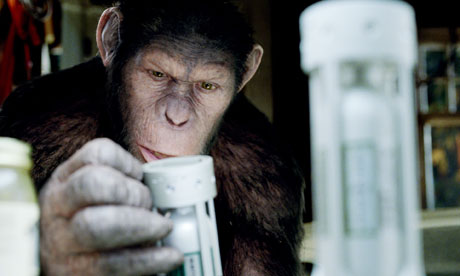
The film follows Will Rodman (James Franco) who is working on a chemical compound designed to cure Alzheimer’s Disease, which happens to afflict his father. Through a chimpanzee test subject named “Bright Eyes,” Rodman discovers that his compound not only rebuilds damaged brain tissue, but significantly increases intelligence. When his study is suddenly scrapped, following a lab accident, Rodman is forced to put-down all of his primate test subjects and is left to raise a young Chimpanzee named Caesar -- who has genetically inherited super-intelligence from his mother. As Caesar grows, it becomes difficult for the chimp to make sense of his role in a human world, as well as withstand his animal impulses, i.e., when Caesar violently attacks an ass-hole neighbor in order to protect a confused Charles, the police throw Caesar into an animal control facility with regular stupid apes.

And that’s where Rise of the Planet of the Apes goes from good to great. Wyatt takes his time developing the character of Caesar and while Franco may be the “star” of the film, it really belongs to Serkis and the special effect geniuses at WETA. Will becomes a background character as he struggles to get Caesar released while trying to update ALZ-112 to into an aerosol form that can better fight off antibodies. The movie breezes through these scenes because where its heart truly lies is with Caesar developing his relationship with his other prisoners and staging an escape.
By far the strongest element of the film is Caesar’s arc -- which successfully presents a mostly non-verbal evolution of the character from a reckless and charming baby chimpanzee to a contemplative but dangerous adolescent. Weta’s digital protagonist, coupled with another incredibly life-like performance from Andy Serkis, work to create one of the most intriguing connections to an entirely digital character that audiences will have ever experienced. In the end, it’s not just that Caesar looks real -- the character, through both the remarkable physical appearance as well as his onscreen actions, is genuinely brought to life.


Surprisingly, the human characters aren’t quite as well realized. Where Caesar’s evolution is unique and compelling, most of the other actors in the film are reduced to very traditional roles. Franco’s Rodman is the obsessed but sensitive scientist who breaks the rules for all the right reasons. The actor does a competent job of interacting with the CGI Caesar -- as well as pumping some believable emotion into the human-side of the equation. However, even a talented performer like Franco is somewhat held-back by the film’s interest in his ape counterpart; as a result, Rodman is mostly reacting to the things happening around him -- and isn’t given much room to evolve. Similarly, Freida Pinto plays Caroline Aranha, a veterinarian that becomes involved with Rodman -- another character that is mostly defined by a relationship, not her actions. Again, Pinto delivers a okay performance in the role but isn’t given anywhere to take it. Lithgow delivers a few charming moments, but the other supporting characters -- specifically cruel animal sanctuary wardens John and Dodge Landon (Brian Cox and Tom Felton, respectively) -- are one-note caricatures -- as is David Oyelowo’s money-hungry executive, Steven Jacobs. It’s an ironic state of affairs that -- in a film about apes that break free from the confines of human oppression -- it is the human actors who are restrained by the weight of their digital colleagues.
In spite of the CGI action-heavy finale, Rise of the Planet of the Apes is mostly a plodding character drama -- one that features a number of tense, but mostly small-scale, encounters. While everything that’s depicted onscreen is interesting, and successfully works to develop Caesar’s character, the film does get bogged-down at times. The final act offers a number of interesting visuals (most notably an empty suburban street lined with trees -- and falling leaves) and successfully depicts the actual rise of the apes -- but anyone expecting a large-scale, action-packed, finale might be a little let-down. However, for viewers who are locked into the film’s character moments, the final set-piece manages to deliver both a dramatic and emotional pay-off -- not to mention successfully ties the film to the overarching franchise .

Although I think a few things should be cleared up. The trailers and the TV spots make it look like this is the beginning of a revolution and we’re going to see how the apes rose up and defeated humanity. That’s not what happens and while I won’t spoil Caesar’s ultimate goal, I will say that the movie doesn’t try to make anyone seriously believe that the planet could be taken over by apes no matter how intelligent, agile, or physically imposing they may be. The movie cheats a little in showing how many apes charge through San Francisco, but there’s nowhere near enough apes in the city or on the planet for any viewer to believe that they could bring down humanity.

It’s important to note that, for anyone who might be turned-off by the campy sci-fi roots of the film, the tie-ins are ancillary to the far more compelling story of Caesar’s psychological evolution. As mentioned, the heavy-handed Planet of the Apes branding may dominate the film’s marketing campaign, but the actual story and characters depicted onscreen successfully rise above the PR blitz to deliver a unique and compelling movie-going experience.

So, I may not have seen any other planet of the apes movie (excluding this one) besides Tim Burton's but yes its a worthy addition to the brand name.

Share/Bookmark

Thursday, August 18, 2011

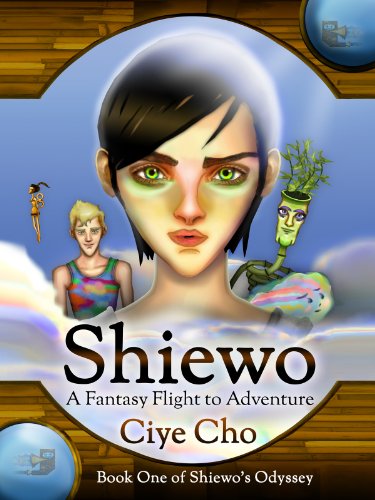
Shiewo: A Fantasy Flight to Adventure

Preferable for the 13 up group. I present before you all, Shiewo: A Fantasy Flight to Adventure by Ciye Cho.

Here is the summary of the book:

The universe of Orberana is a place of great wonder and peril, a dizzying landscape filled with clouds that can talk, clockwork beings that mark their own time, and painted animals that awake in the night. Shiewo Morose is the captain of a flying ship powered by music. She is also a determined young woman on a mission: a quest to find the Wishing Fish that created Orberana. Sailing above the clouds, Shiewo and her crew (Erduu the bamboo, Theo the cloud, Livingston the goldfish, and Felix the painter) are headed for worlds of crazed clockwork bureaucrats, tyrannic kings, and tornado children--worlds that will test not only the crew's bravery... but their very understanding of adventure. Theirs is the odyssey of a lifetime...
It is a world full of colours that come in every shade and form....well I suppose it correctly assumes the fat that the world which we are about to enter is well weird to a T...but it is also the land of dreams for any fantasy lovers.

Our story begins with Felix, a young artist in Galvanary (weird name for a city) who tries everything within his reach to turn his little world in the smog filled city a bit colourful via his art and his colours. One day his life suddenly takes a complete u-turn. His encounters with a cloud, a bamboo man and a ship captain with an attitude changes it all. He goes after them cause they have stolen something that belongs to him....his roof seriously (o.O) but all this goes down the drain when he finds the reason why they wanted his roof. They want to find the originator of Orbenara a.k.a. the wishing fish.

But that is not all, their ship with which they hope to track this mythical creature is shaped as a fish and the strangest detail of all....it runs with music (hmm....nice use of the physics of sound..impressive)

While this is just the beginning - a start to their adventure but yes more is to come and with each bounding task, they grow stronger and wiser.

All in all not bad - although i got bored through it a bit. maybe the reason being that the story is meant for adults or young adults for that matter. But yes the author Ciye Cho does a good job with it - very imaginative - very colourful - and very musical. Kids will definitely enjoying this adventure of a "different" kind.

Share/Bookmark
Related Posts Plugin for WordPress, Blogger...