
 It started with 'Caesar' then changed to 'Rise of the Apes' and finally Rise of the Planet of the Apes. While yes so many title changes may as per usual attribute to Hollywood selling style over substance. It wouldn’t be the first time that Hollywood has attempted to revive Planet of the Apes -- with even Tim Burton struggling to deliver an enjoyable modern remake. And Rupert Wyatt's revival of the iconic hit definitely works.
And that’s where Rise of the Planet of the Apes goes from good to great. Wyatt takes his time developing the character of Caesar and while Franco may be the “star” of the film, it really belongs to Serkis and the special effect geniuses at WETA. Will becomes a background character as he struggles to get Caesar released while trying to update ALZ-112 to into an aerosol form that can better fight off antibodies. The movie breezes through these scenes because where its heart truly lies is with Caesar developing his relationship with his other prisoners and staging an escape.


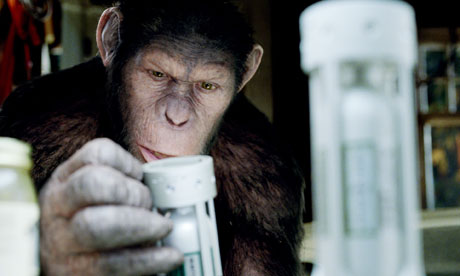
By far the strongest element of the film is Caesar’s arc -- which successfully presents a mostly non-verbal evolution of the character from a reckless and charming baby chimpanzee to a contemplative but dangerous adolescent. Weta’s digital protagonist, coupled with another incredibly life-like performance from Andy Serkis, work to create one of the most intriguing connections to an entirely digital character that audiences will have ever experienced. In the end, it’s not just that Caesar looks real -- the character, through both the remarkable physical appearance as well as his onscreen actions, is genuinely brought to life.
Surprisingly, the human characters aren’t quite as well realized. Where Caesar’s evolution is unique and compelling, most of the other actors in the film are reduced to very traditional roles. Franco’s Rodman is the obsessed but sensitive scientist who breaks the rules for all the right reasons. The actor does a competent job of interacting with the CGI Caesar -- as well as pumping some believable emotion into the human-side of the equation. However, even a talented performer like Franco is somewhat held-back by the film’s interest in his ape counterpart; as a result, Rodman is mostly reacting to the things happening around him -- and isn’t given much room to evolve. Similarly, Freida Pinto plays Caroline Aranha, a veterinarian that becomes involved with Rodman -- another character that is mostly defined by a relationship, not her actions. Again, Pinto delivers a okay performance in the role but isn’t given anywhere to take it. Lithgow delivers a few charming moments, but the other supporting characters -- specifically cruel animal sanctuary wardens John and Dodge Landon (Brian Cox and Tom Felton, respectively) -- are one-note caricatures -- as is David Oyelowo’s money-hungry executive, Steven Jacobs. It’s an ironic state of affairs that -- in a film about apes that break free from the confines of human oppression -- it is the human actors who are restrained by the weight of their digital colleagues.
Surprisingly, the human characters aren’t quite as well realized. Where Caesar’s evolution is unique and compelling, most of the other actors in the film are reduced to very traditional roles. Franco’s Rodman is the obsessed but sensitive scientist who breaks the rules for all the right reasons. The actor does a competent job of interacting with the CGI Caesar -- as well as pumping some believable emotion into the human-side of the equation. However, even a talented performer like Franco is somewhat held-back by the film’s interest in his ape counterpart; as a result, Rodman is mostly reacting to the things happening around him -- and isn’t given much room to evolve. Similarly, Freida Pinto plays Caroline Aranha, a veterinarian that becomes involved with Rodman -- another character that is mostly defined by a relationship, not her actions. Again, Pinto delivers a okay performance in the role but isn’t given anywhere to take it. Lithgow delivers a few charming moments, but the other supporting characters -- specifically cruel animal sanctuary wardens John and Dodge Landon (Brian Cox and Tom Felton, respectively) -- are one-note caricatures -- as is David Oyelowo’s money-hungry executive, Steven Jacobs. It’s an ironic state of affairs that -- in a film about apes that break free from the confines of human oppression -- it is the human actors who are restrained by the weight of their digital colleagues.


In spite of the CGI action-heavy finale, Rise of the Planet of the Apes is mostly a plodding character drama -- one that features a number of tense, but mostly small-scale, encounters. While everything that’s depicted onscreen is interesting, and successfully works to develop Caesar’s character, the film does get bogged-down at times. The final act offers a number of interesting visuals (most notably an empty suburban street lined with trees -- and falling leaves) and successfully depicts the actual rise of the apes -- but anyone expecting a large-scale, action-packed, finale might be a little let-down. However, for viewers who are locked into the film’s character moments, the final set-piece manages to deliver both a dramatic and emotional pay-off -- not to mention successfully ties the film to the overarching franchise .
Although I think a few things should be cleared up. The trailers and the TV spots make it look like this is the beginning of a revolution and we’re going to see how the apes rose up and defeated humanity. That’s not what happens and while I won’t spoil Caesar’s ultimate goal, I will say that the movie doesn’t try to make anyone seriously believe that the planet could be taken over by apes no matter how intelligent, agile, or physically imposing they may be. The movie cheats a little in showing how many apes charge through San Francisco, but there’s nowhere near enough apes in the city or on the planet for any viewer to believe that they could bring down humanity.
It’s important to note that, for anyone who might be turned-off by the campy sci-fi roots of the film, the tie-ins are ancillary to the far more compelling story of Caesar’s psychological evolution. As mentioned, the heavy-handed Planet of the Apes branding may dominate the film’s marketing campaign, but the actual story and characters depicted onscreen successfully rise above the PR blitz to deliver a unique and compelling movie-going experience.
So, I may not have seen any other planet of the apes movie (excluding this one) besides Tim Burton's but yes its a worthy addition to the brand name.


